Within the Middle East's recycled copper raw materials export landscape, the top three exporting countries are the UAE, Saudi Arabia, and Turkey. According to SMM data, these three countries collectively exported nearly 300,000 physical tons of recycled copper raw materials in 2025, accounting for over 90% of the Middle East's total recycled copper exports. While 300,000 tons is a notable figure in absolute terms, its share of global recycled copper raw material trade is not particularly large. This means that even if supply from the region experiences temporary disruptions, the impact on global recycled copper raw material output remains quite limited.
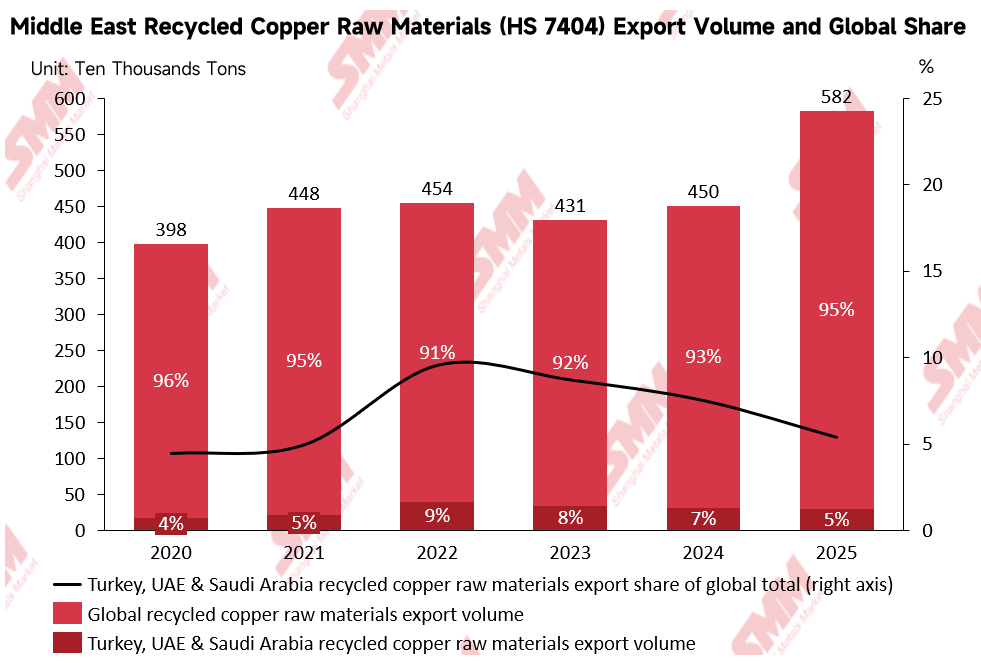
Data sources: GTT and SMM. All data cited in this article is classified under customs code HS7404.
The destination of Middle East recycled copper raw materials is clear: approximately 80% of its exports flow to Asia, with China and India as the primary destinations, and the remainder going to South Korea, Japan, and other markets. However, in proportional terms, Middle Eastern scrap copper accounts for only a small share of total imports for major consuming nations such as China and India. For these countries, procurement channels have long been diversified on a global scale, with supply from Southeast Asia, Europe, the Americas, and South America forming a more robust supply base. As such, ripples from the Middle East situation are currently insufficient to generate any material impact on Asia's recycled copper raw materials market.
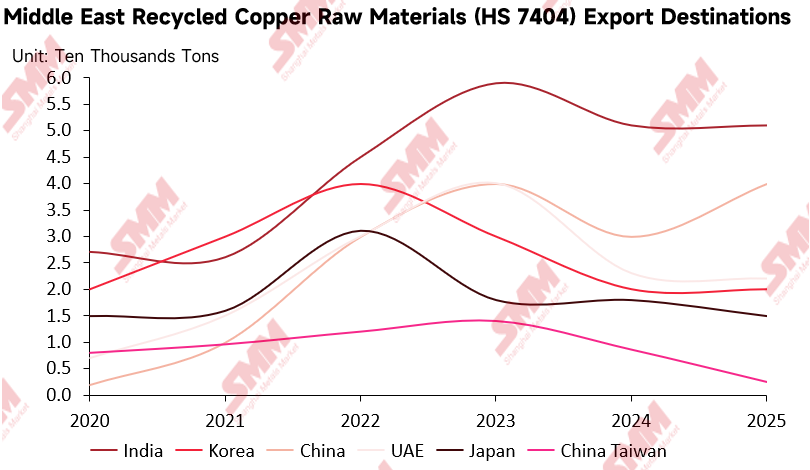
Data sources: GTT and SMM. All data cited in this article is classified under customs code HS7404.
Although the Middle East situation has not yet caused severe disruption to the global recycled copper raw materials market, the potential indirect consequences of a further escalation remain worth monitoring. These potential indirect effects include logistical disruptions: critical shipping lanes such as the Red Sea could force shipping companies to reroute, which would not only directly push up freight rates but also significantly extend transit times, increasing traders' working capital costs. Furthermore, as an energy hub, developments in the Middle East tend to drive energy price volatility and produce cascading effects, providing support for higher copper prices and indirectly lifting recycled copper raw material pricing. Additionally, given the Middle East's role as a key conduit in global sulfur trade, any suspension of shipping through its waterways is also expected to have a far-reaching impact on sulfur and sulfuric acid prices.
Overall, the Middle East situation has not yet triggered a substantive supply crisis for the global or Asian recycled copper raw materials market. For recycled copper consumers and traders across Asia, rather than fixating on distant geopolitical smoke, it is more prudent to return focus to the market fundamentals closer to home.


![The Most-Traded BC Copper Contract Closed Down 1.47%, a Stronger US Dollar Index Put Copper Prices Under Pressure [SMM BC Copper Commentary]](https://imgqn.smm.cn/usercenter/Fxolk20251217171712.jpg)